
The New Paradigm: From Rivalry to Unified Ecosystem
Over the last decade, the creative industry narrative was built on a false dichotomy: ‘amateur’ tools versus ‘professional’ software. However, Canva’s acquisition of Serif (Affinity’s developer) in March 2024 was not just a $380 million transaction; it was the definitive signal of a tectonic shift in global graphic design. For the beginner designer, this invalidates the old mindset of exclusion. It is no longer about choosing a side, but understanding a hybrid ecosystem where Canva’s agility and Affinity’s technical depth operate in symbiosis. Canva democratized access to fast visual composition, allowing ‘design thinking’ to permeate marketing and HR departments without technical barriers. Conversely, Affinity remained true to the heritage of precision, offering absolute control over vectors, Bézier curves, and CMYK color management for high-fidelity printing. The professional of 2025 is not one who rejects the ease of ‘drag and drop,’ but one who knows when the complexity of vector software is required. Authority in design now resides in the ability to transition fluidly between rapid ideation and rigorous technical execution.
Table of Contents
Semiotics & Hierarchy: Ease vs. The Blank Canvas

Analyzing the psychology behind these tools reveals fundamentally opposing approaches that shape the designer’s eye. Canva, with its vast library of templates, operates under a logic of ‘pre-fabricated design,’ where visual hierarchy (size, color, typographic weight) has already been solved by third parties. For the beginner, this is a double-edged sword: it offers immediate aesthetic results but may atrophy the development of a critical eye regarding *why* something works. Affinity (whether Designer, Photo, or Publisher) presents the terrifying and necessary challenge of the blank canvas. Here, nothing exists until you decide. Semiotics—the study of signs and meanings—must be built from scratch. The designer is forced to understand Gestalt: how proximity, similarity, and continuity guide the viewer’s eye. True mastery emerges when the beginner uses Affinity to create the ‘atoms’ of design (custom icons, complex image treatments, unique vector illustrations) and uses Canva merely as the assembly and distribution stage. Understanding this distinction is what separates a tool operator from an Art Director in training. Ease should never replace fundamentals; it should only accelerate the process after fundamentals are established.
The Technical Bridge: Vectors, Pixels, and Precision
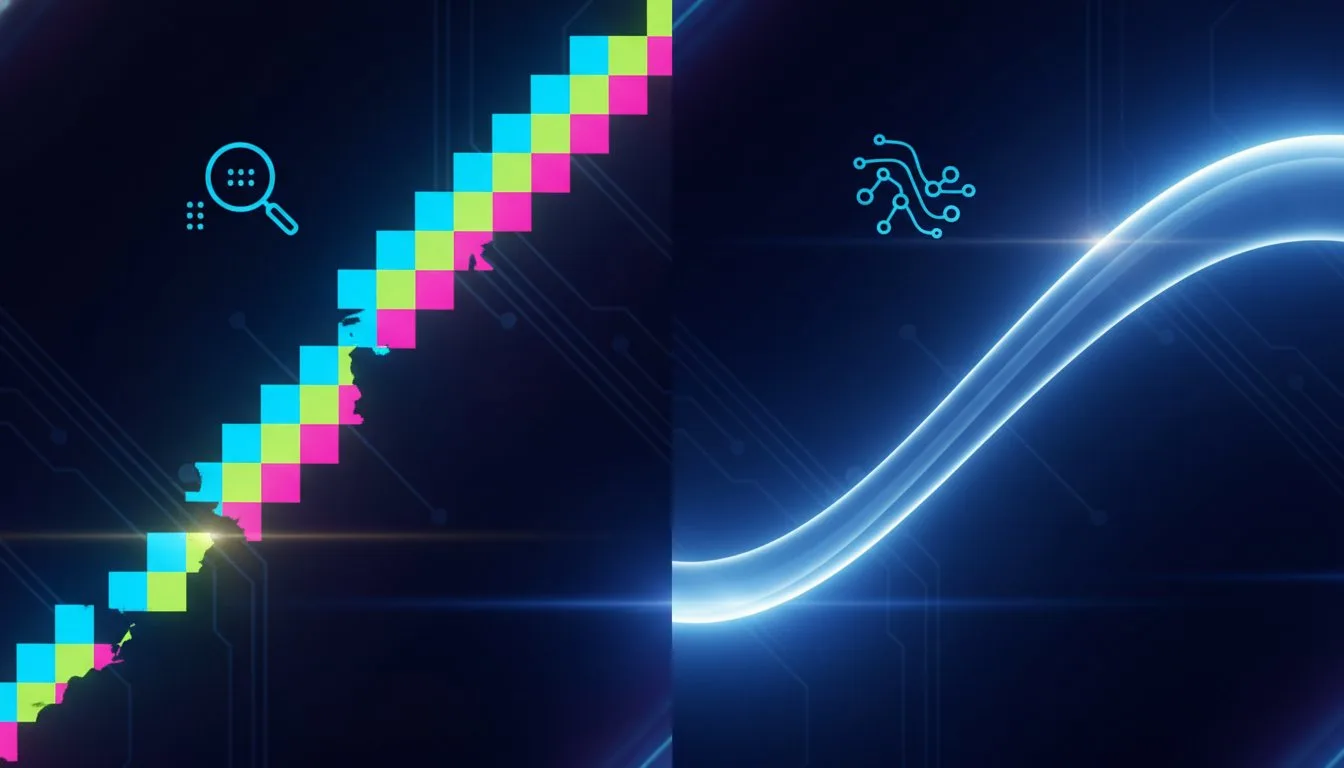
Beneath the surface of the user interface resides the most critical technical distinction every beginner must master: the mathematical difference between vectors and pixels (raster). Canva, though it has evolved, operates primarily as an element composer, often treating vectors with limitations or converting them for fast web visualization. This is where Affinity becomes indispensable. A logo, by definition, requires infinite scalability—it must work on both a business card and a billboard. This is only possible through the mathematical manipulation of curves and nodes, territory where Affinity Designer shines with surgical precision tools (Pen Tool, non-destructive boolean operations). Attempting to create a robust visual identity solely in Canva is a grave technical error, as it limits the brand’s adaptability across physical media and large formats. Furthermore, isometric grid control and advanced typography management (kerning, tracking, manual ligatures) in Affinity Publisher allow for editorial layouts that breathe professionalism. The beginner designer must view Affinity as their chemistry lab, where elements are purified and created, and Canva as the storefront, where the final product is packaged for rapid consumption.
Future Creative Flow: The Hybrid Professional
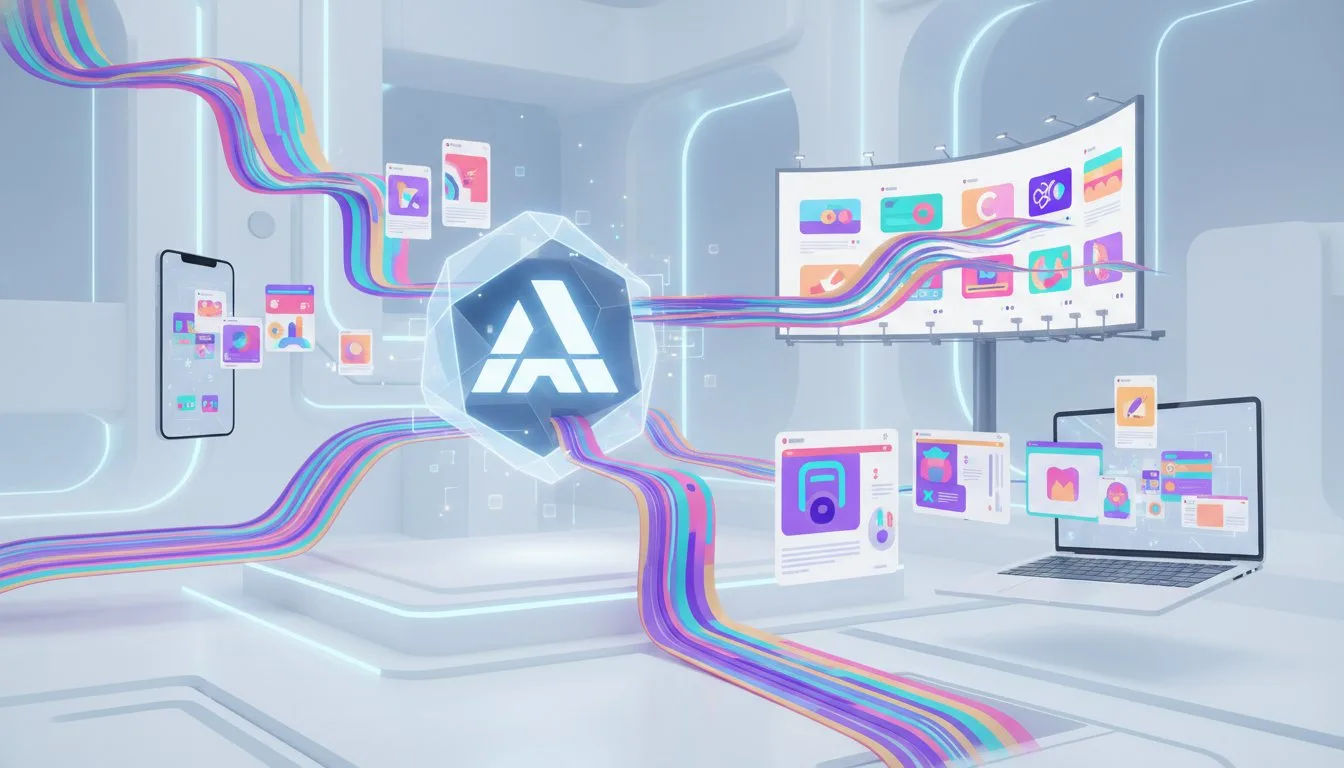
Looking toward the horizon of 2025 and beyond, the integration between these platforms points to the rise of the ‘Hybrid Professional.’ Modern agencies and marketing departments no longer have patience for purism that delays deliveries, nor tolerance for amateurism that devalues the brand. The winning workflow involves creating high-fidelity assets in Affinity—leveraging the perpetual license and local machine power—and exporting these assets to brand libraries in Canva Enterprise. This allows non-creative teams to assemble on-brand presentations and posts without breaking the design system established by the lead designer. Artificial intelligence, present in both (with Canva’s Magic Studio and Affinity’s smart selection tools), will act as an accelerator, not a substitute. For you, the beginner, the lesson is clear: do not specialize in one tool, specialize in *visual problem solving*. Learn to draw the perfect vector in Affinity to ensure quality, and learn to create the flexible template in Canva to ensure scale. Those who master this duality will not only survive automation but will lead multidisciplinary teams.