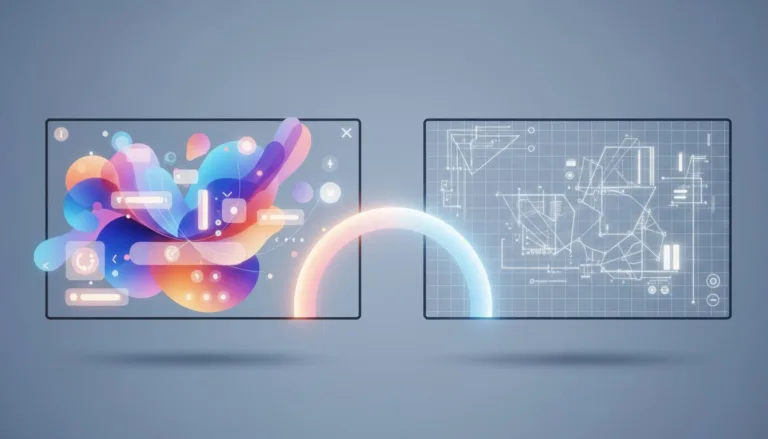

Access Hegemony & Visual Revolution
Contemporary graphic design is at a critical turning point, marked by Canva’s recent acquisition of Serif (creator of the Affinity suite). For the beginner designer, understanding this shift is not just about market news, but about understanding the evolution of creation tools itself. Historically, we lived under a technical dictatorship where mastering complex, expensive software was mistakenly confused with design proficiency. Canva emerged as a democratic disruptor, removing technical entry barriers and allowing visual thought to flow without the friction of hostile interfaces. However, this democratization brought the risk of aesthetic banalization, where the tool dictates the result rather than the creator. On the other hand, the Affinity suite (Designer, Photo, and Publisher) established itself as the bastion of professional resistance against predatory subscription models, offering mathematical precision and absolute control over vectors and pixels. In 2025, the coexistence of these platforms under the same corporate umbrella signals the end of the ‘amateur vs. professional’ dichotomy. We are witnessing the birth of a hybrid workflow, where browser agility meets desktop depth. For the designer starting their journey now, it is imperative to recognize that the barrier between ‘doing it fast’ and ‘doing it precisely’ has dissolved. The true competitive edge no longer lies in tool access, but in the intellectual capacity to transition between rapid ideation and rigorous technical execution.
Table of Contents
Canva & Efficiency Semiotics: Standardization Risks
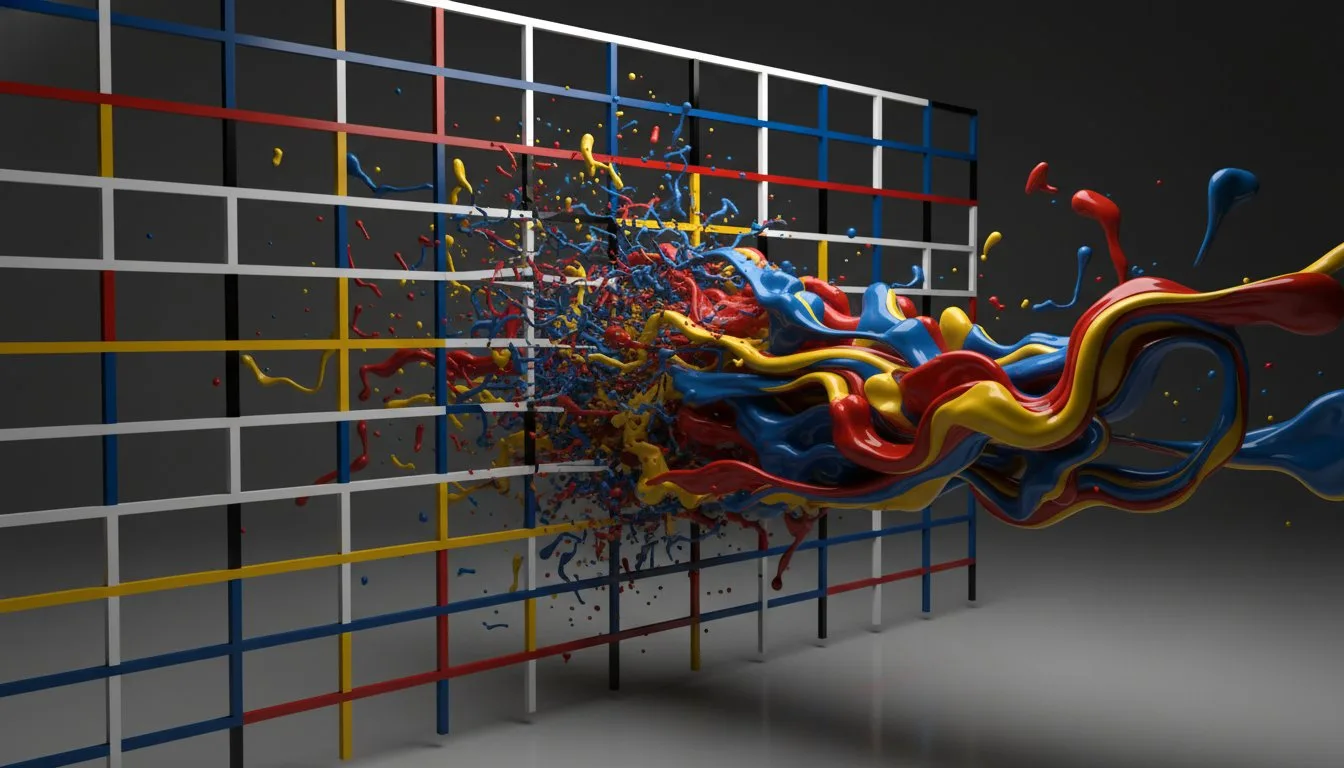
Analyzing Canva through the lens of design theory, we see it operates as a vast repository of pre-fabricated semiotics. Its automated grid systems and typographic hierarchies are founded on solid Gestalt principles, ensuring balance and proximity are maintained even by lay users. This is simultaneously its greatest virtue and its most seductive trap. For the beginner designer, the danger lies in ‘template dependency.’ By utilizing ready-made visual solutions, the professional risks atrophying their ability to solve complex visual problems, becoming a layout operator rather than an information architect.The color psychology applied within the Canva environment often follows ephemeral market trends, which can lead to a homogenization of global visual culture. The designer must use the platform with a critical mindset, deconstructing the offered models to understand *why* they work, rather than merely accepting them. The challenge here is to impose one’s own authorial voice over the tool’s algorithmic structure. Canva’s efficiency should be used for rapid prototyping and social media asset management, but it must never replace deep study regarding composition, contrast, and the psychological impact of forms. True design happens in the mind before any click, and Canva should serve as an accelerator of this thought, not a substitute for it.
Affinity & Vector Discipline: Absolute Control

While Canva focuses on the composition of existing elements, the Affinity suite demands the designer assume the role of demiurge, creating forms from absolute nothingness. Mastery of Affinity Designer, for example, is an exercise in applied geometry and vector mathematics. Here, the manipulation of Bézier curves is not just a technical skill, but an art form requiring patience and spatial vision. Precision in node control, advanced color management (including CMYK color spaces for high-fidelity printing and Spot Colors), and fine-tuning kerning and tracking in typography are what separate amateur design from authoritative design.For the beginner, Affinity’s learning curve may seem steep, but it is essential. It is in this environment that one understands the bone structure of design. Working with non-destructive layer masks, complex blend modes, and the fluid integration between vector and raster (Designer’s Pixel Persona) teaches image construction at a molecular level. The psychology behind using professional tools like Affinity involves a different state of ‘flow,’ slower and more deliberate, where every visual decision is intentional. The visual impact of a logo or editorial layout built with this precision is subconsciously perceived by the audience as more trustworthy and valuable. Therefore, Affinity is not just software; it is the workshop where the visual artisan refines their technique.
Professional Synthesis: The Future Workflow

The inevitable conclusion for the designer seeking relevance in the current market is strategic integration. It is not about choosing between Canva and Affinity, but knowing *when* to use each to maximize impact and efficiency. The modern professional must be capable of vectorizing a complex visual identity in Affinity Designer, ensuring the brand’s mathematical integrity, and exporting these assets to Canva, creating a design system (Brand Kit) that allows scalability and speed in daily content production. This fluidity between the ‘atelier’ (Affinity) and the ‘factory’ (Canva) is the most valuable competence in 2025.Furthermore, a deep understanding of theoretical foundations—color theory, the golden ratio, semiotics—becomes the only transferable constant. Tools will change; Affinity’s acquisition by Canva proves the market is volatile. However, the eye trained to perceive visual imbalances or inconsistencies in brand messaging operates independently of software. The beginner designer must focus on being a visual polymath: technically proficient to manipulate digital matter with surgical precision in Affinity, and strategically agile to communicate en masse through Canva. Design authority is born from this synthesis: the capacity to deliver refined art with the speed the digital world demands.